









GPT-6 Intrinsic Protein Design Explained: What OpenAI's Lab Results Mean for GPT-6.2 Astra & Sol Users
Short answer: Yes, OpenAI's November 24, 2026 protein-design release is a genuine milestone—not because GPT-6 replaces wet labs, but because GPT-6.2 designed working protein sequences and antibody binding loops using only general-purpose reasoning and Python code, without calling a dedicated biology generator. In lab experiments with Onava, GPT-6.2 designs showed binding across 5 targets, achieved a 13.1% hit rate (14/107) on novel sequences for unpublished 3D structures, and preserved binding in 70% of redesigned VHH antibody loops (128/182) and 66% of therapeutic antibody fragments (179/272). For everyday researchers, engineers, and developers, the practical takeaway is that general frontier reasoning in GPT-6.2 Astra and GPT-6.2 Sol now transfers directly into structured scientific, math, and code-driven workflows.
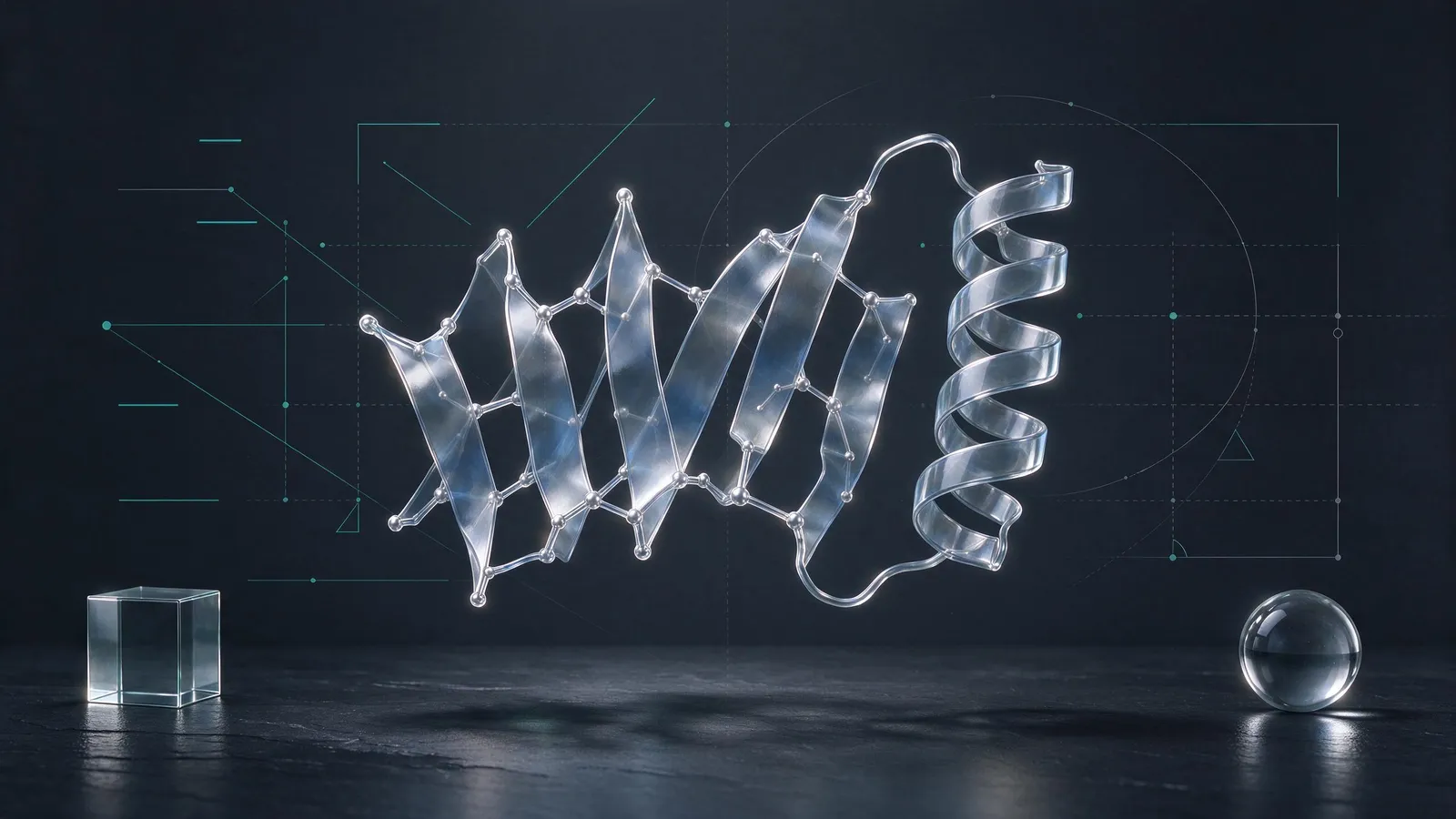 Minimalist editorial scientific illustration of a translucent glass 3D protein alpha-helix and beta-sheet ribbon floating above a sleek dark slate workspace with subtle cyan and silver geometric reasoning grid lines, clean modern studio lighting, no text
What OpenAI Actually Announced on November 24, 2026
In its research report—GPT-6 as a Universal Foundation Model for Protein Biology: Beyond Specialized Models—OpenAI tested whether general-purpose GPT-6 models possess intrinsic protein-design capabilities.
Until now, de novo protein design required chaining together multiple specialized biology models (such as structure generators like RFdiffusion and sequence designers like ProteinMPNN). Each tool expects rigid input formats and structural constraints; adding a new requirement—like forcing a specific secondary structure count or specifying an atomic bond—typically meant modifying code or retraining a specialized pipeline.
OpenAI's core finding is that the GPT-6 family can handle those constraints directly through natural-language prompts, step-by-step reasoning, and general-purpose coding tools:
- Pure reasoning + code generation: The models reasoned over math, physics, chemistry, and structural biology principles to generate 3D protein coordinates and amino acid sequences without invoking external biology generators for design.
- Fine-grained prompt control: Researchers could guide designs from a single atomic bond up to global fold topology—specifying whether a minibinder should use all helices, all strands, or a mixed fold, and even how many coils or strands to include.
- Zero retraining between tasks: Switching from small-molecule docking prediction to minibinder design or antibody loop redesign required changing only the prompt.
Breaking Down the Real Lab & Computational Numbers
Hype around "AI biology breakthroughs" often blurs the line between computational benchmarks and actual wet-lab validation. OpenAI separated the two clearly, and the distinction matters:
| Experiment / Benchmark | Model Tested | Key Measured Result | Why It Matters |
|---|---|---|---|
| Minibinder design across 5 targets (Onava wet lab) | GPT-6.2 | Evidence of binding across all 5 targets | Confirms generated 3D shapes fold and attach in physical lab assays (specialized models only assisted with sequence supply & candidate filtering) |
| New sequences for unpublished 3D structures (PD-L1, IL-7Rα) | GPT-6.2 | 14 / 107 (13.1%) showed binding | Two working PD-L1 sequences differed from the original at 52 and 58 of 90 amino acids (and 44 positions from each other)—strong evidence against memorization |
| VHH antibody loop redesign (IL-4Rα, 6 VHHs) | GPT-6.2 | 128 / 182 (70%) retained binding | Rebuilt all 3 binding loops from scratch given the rest of the structure |
| Therapeutic antibody fragment redesign (PD-1 / PD-L1, 5 antibodies) | GPT-6.2 | 179 / 272 (66%) retained binding | Modified ~50% of amino acids across 3 binding loops while keeping the framework intact |
| Motif scaffolding (30 enzyme & binding challenges, computational) | Internal GPT-6 research model | 43.7% success vs. 27.8% for RFdiffusion | Outperformed a leading specialized baseline in computational folding verification (wet-lab enzyme catalysis still pending) |
Honest Caveats You Should Not Gloss Over
- Internal model vs. public GPT-6.2: The 43.7% motif-scaffolding headline came from an internal OpenAI research model, not a public checkpoint. However, the wet-lab experiments (5 targets, 13.1% novel sequence hits, 70% VHH and 66% therapeutic antibody loop redesigns) were explicitly run with GPT-6.2.
- Specialized models are not obsolete yet: Even in OpenAI's own wet-lab workflow, specialized tools (like ProteinMPNN and structure-prediction filters) still helped propose candidate sequences and rank which designs to synthesize.
- Computational success ≠ clinical drug: Binding in an assay is an early-stage signal, not a finished therapeutic. Wet-lab synthesis, stability, immunogenicity, and delivery remain real-world bottlenecks.
What This Signals for Everyday Technical, Research & Coding Work
Even if you never touch a PDB file or design a minibinder, this release reveals something important about how GPT-6.2 reasons:
- Constraint-following over long chains of math + code: Specifying "design a binder with 3 helices, bury residue X, and keep 50% of loop residues unchanged" is structurally similar to complex software architecture, quantitative modeling, or hardware/CAD constraint solving.
- Reasoning models that write their own verification scripts: GPT-6.2 did not just hallucinate plausible-looking coordinates—it wrote code to check geometry, distances, and chemical constraints iteratively.
- Cross-model verification is still essential: In high-stakes research or engineering, relying on one model family creates blind spots. Running the same derivation or codebase question through GPT-6.2 Astra, Claude Opus 5.5, and Gemini 4 Carbon side by side catches silent assumptions far faster than re-prompting one chatbot.
Can You Try GPT-6.2 Today on aiwith.chat? (Honest Availability Check)
Let's be completely transparent about what is—and is not—live right now on aiwith.chat:
- Not available: OpenAI's unreleased internal research model from the motif-scaffolding benchmark is not publicly accessible on any platform, including ChatGPT or aiwith.chat.
- Live right now on
/gpt: You can use GPT-6.2 Astra (OpenAI's flagship reasoning model for complex technical and scientific work), GPT-6.2 Sol (balanced frontier intelligence and cost), and GPT-6 Luna (fast, budget-friendly daily driver) directly at aiwith.chat/gpt. - Side-by-side frontier alternatives in the same workspace:
- Claude Opus 5.5, Fable 5.1, Sonnet 5.5 & Haiku 5.5 — ideal for long technical writing, nuanced code refactors, and paper synthesis.
- Gemini 4 Carbon, Neon & Hydrogen — strong for multimodal diagram reading, huge-context literature reviews, and fast iteration.
- DeepSeek V4.1 Flash / V4 Pro & Kimi K3.1 Pro — high-efficiency reasoning and coding workhorses when you want to conserve credits.
Cost Comparison: Single-Vendor Subscriptions vs. One Multi-Model Workspace
If you test GPT-6.2 alongside Claude and Gemini for research, engineering, or coding, paying for separate subscriptions adds up quickly:
| Option | Monthly Price | Frontier Models Included | Payment & Flexibility |
|---|---|---|---|
| ChatGPT Plus + Claude Pro + Google AI Pro | $60/mo ($20 × 3) | GPT-6, Claude, Gemini (3 separate apps & histories) | 3 recurring subscriptions, international card required |
| Single-vendor ChatGPT Plus only | $20/mo | OpenAI models only (no Claude 5.5 or Gemini 4) | Hard message caps on top reasoning tiers |
| aiwith.chat Standard | $9.9/mo (3.2M credits) | GPT-6.2 Astra & Sol, GPT-6 Luna, Claude 5.5 / Fable 5.1, Gemini 4 Carbon / Neon, DeepSeek V4.1, Kimi K3.1 Pro | Stripe, Alipay & WeChat Pay supported; switch models in one workspace |
| aiwith.chat Pro | $19.9/mo (7.2M credits) | Same full frontier roster with 2.25× credit pool | Built for heavy daily reasoning, coding & long-document workflows |
New accounts on aiwith.chat start with 5,000 free credits so you can benchmark GPT-6.2 Sol or GPT-6 Luna on your own prompts before paying a cent.
Practical Verdict: Who Should Switch—and Who Shouldn't?
- Computational biologists & structural researchers: Keep your specialized pipeline (ProteinMPNN, AlphaFold/folding predictors, docking suites), but start testing GPT-6.2 Astra as a natural-language reasoning and scripting co-pilot for hypothesis generation, constraint exploration, and code glue.
- Software engineers, quant analysts & STEM grad students: This is the clearest signal yet that GPT-6.2 Astra excels at tight, multi-constraint technical reasoning. Use GPT-6 Luna or DeepSeek V4.1 Flash for routine queries, and escalate hard architecture, math, or debugging problems to GPT-6.2 Astra or Claude Opus 5.5.
- Casual writers or light daily users: You do not need to pay $20–$200/mo for frontier scientific reasoning. Start with 5,000 free credits on aiwith.chat/gpt or use the $9.9/mo Standard plan only if you regularly cross-check answers across GPT-6.2, Claude 5.5, and Gemini 4.
Source: OpenAI — GPT-6 models demonstrate intrinsic protein-design capabilities (Nov 24, 2026)